Housing camps on Telegram, Spain, autumn 2026
An open, documented repository of ongoing research.

A DataPolitik study by Heurística, Barcelona.
A study of the public Telegram channels of the Spanish housing movement and their allies during the housing camps that followed the eviction of Maricarmen Abascal in Madrid, and in the run-up to the general strike for housing called for 11 November: how the channels were sampled and classified, and what their forwarding and mention networks show.
Periods
| Period | Days (2026) | Channels at the end | Report |
|---|---|---|---|
| First study | 14 September – 5 October | 167 | Technical report · Community analysis · External review · Evidence (CSV) |
| Block 1 | 6–19 October | 265 | Block 1 |
| Block 2 | 20–26 October | 281 | Block 2 |
| Block 3 | 27 October – 2 November | 297 | Block 3 |
| Block 4 | 3–9 November | 339 | Block 4 |
| Strike day | 10 November 22:00 – 12 November 03:00 | 352 | Strike day |
| Block 5 | 10–16 November, with the 11 November strike | in progress |
Blocks 1 onwards extend the first study in weekly blocks, scanning the same channels in every block and adding those that enter the conversation. How they work, and how they compare, is on the follow-up overview; their review decisions are in the follow-up review log (CSV).
Each observation period introduces new data and analyses. Previous reports remain available to document the evolution of the research, including revisions and changes in interpretation.
Across the periods
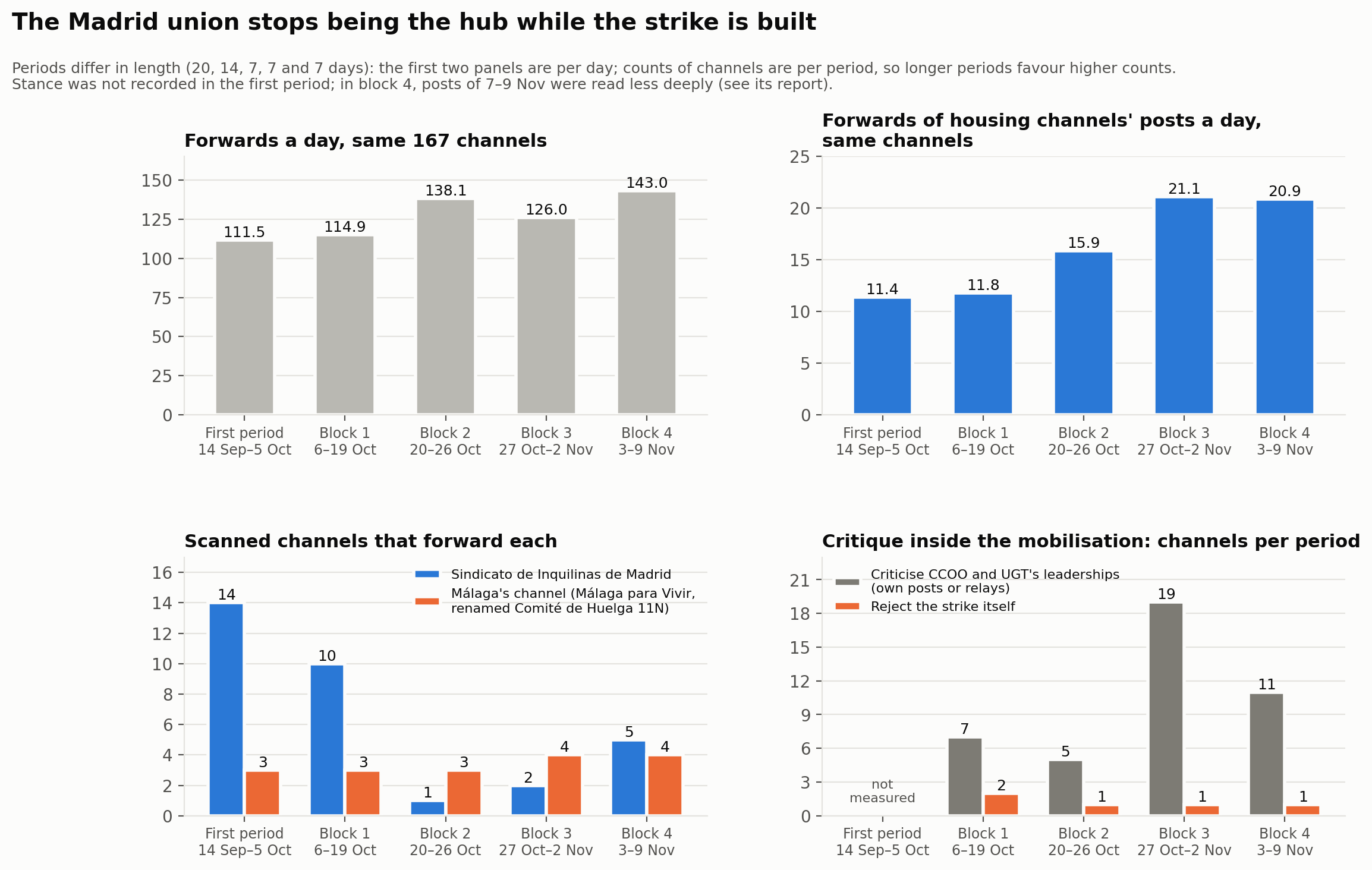
- The Madrid union stops being the hub. The Sindicato de Inquilinas de Madrid is forwarded by 14 channels in the first study and 10 in block 1, after Maricarmen’s death, then by 1, 2 and 5 in blocks 2 to 4.
- Málaga’s strike committee channel carries the forwarding of housing content from block 2, but through the same three or four channels: volume without breadth.
- The mobilisation turns from the camps to the 11 November strike, and its supporters argue about who leads it: channels criticising CCOO and UGT’s leaderships rise from 5 to 19 in a week and are 11 in block 4, the week before the strike, almost all of them backing the strike. Rejection of the strike itself stays marginal.
- Territorial clusters are linked below their housing channels. Housing channels barely forward each other across territories: the first tie, in block 3, is a joint statement by the camps after the Urda rail crash. But 7–11 % of the ties among channels with a known territory cross territories, carried by anarchist, anti-repression and Palestine solidarity collectives, Catalan-language media, and organisations present in several territories such as CGT, whose Madrid and Catalan channels connect through its state-wide channels.
- The camps’ own channels are barely relayed, except the Sol camp’s on the day of its eviction, in block 4.
- The opponents stay closed off: two hostile media channels that no other channel forwards or quotes, joined in block 4 by an author’s channel (recorded from block 1, when the opponent category was introduced).
The strike day. On 11 November the panel posted 3.6 times as much about the mobilisation as on ordinary weekdays, but forwarded only 15 % more. Media and the conveners’ unions covered the day live; housing channels were seldom relayed, and no tie between them crossed a territory. Critique turned to the government over the police charges. See the strike-day page.
The network in each period
Forwarding and mention networks of the scanned channels, one map per period; select a map to open it in its report. Communities are detected separately in each period, so colours and positions are not comparable between maps.
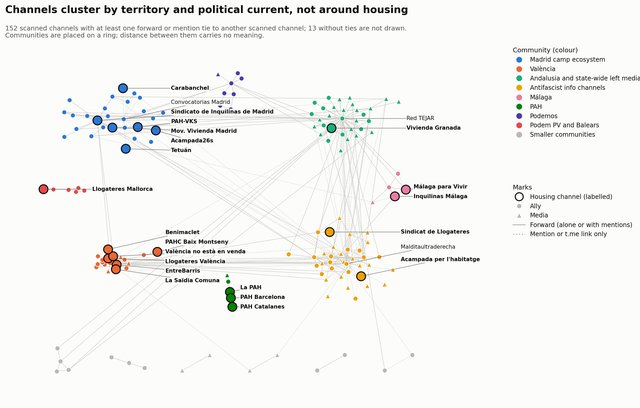 First study
14 Sep – 5 Oct
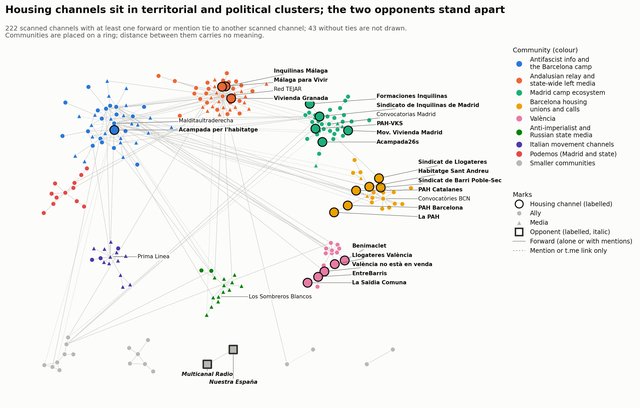 Block 1
6–19 Oct
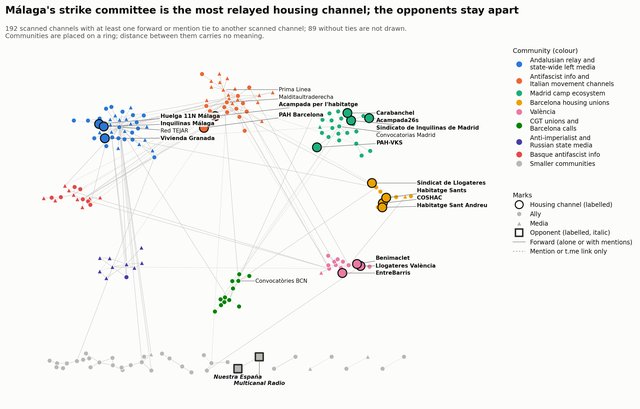 Block 2
20–26 Oct
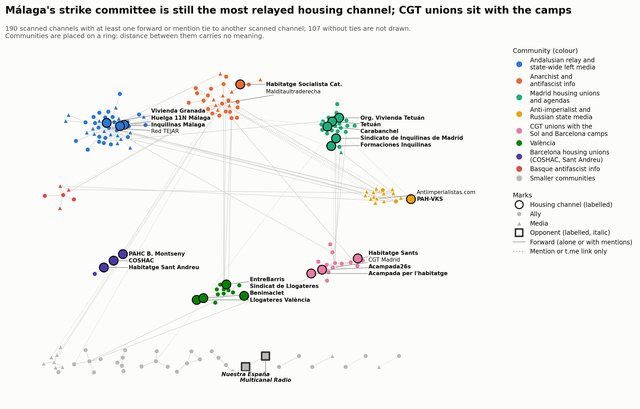 Block 3
27 Oct – 2 Nov
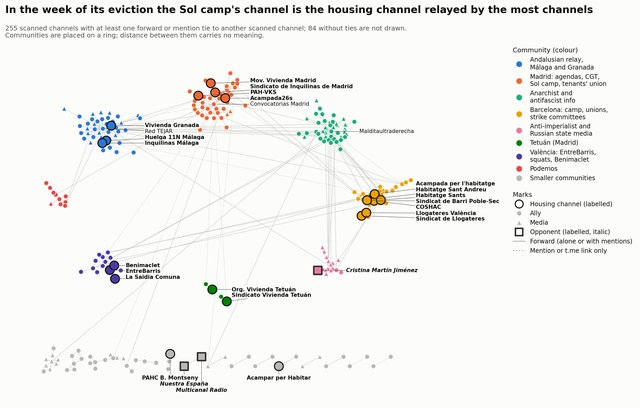 Block 4
3–9 Nov
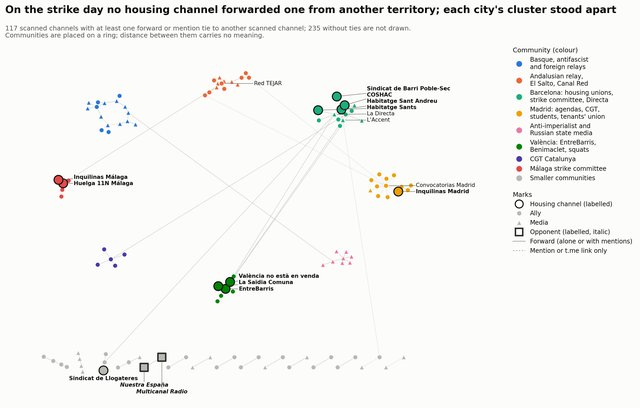 Strike day
10–12 Nov
About this site
This repository brings together successive results from ongoing research into Telegram communication networks surrounding housing mobilisations in Spain. It publishes reports, visualisations, methodological documentation, classification decisions and the processed evidence behind the analyses, so that the research process can be followed, the findings examined critically, and the evolution of the interpretations documented as new observations become available.
The findings are provisional, subject to revision, and do not aim to provide an exhaustive representation of the movement.
- Only public Telegram channels and groups were read, without joining them.
- Collection, classification and analysis were carried out by an AI agent following a written protocol, with the team setting the protocol, taking the decisions that changed the sample or the classification, and reviewing the results.
- Code and raw data are not published.
- In the evidence files, individual user accounts and hidden-name forward origins are pseudonymised, and the text of members’ messages in group chats is removed. Channels are identified by their public username.
- The sample is a snowball from a nine-channel seed, not a census. See the limitations sections before drawing conclusions.
Use and citation of findings
This repository is open to critical examination, discussion, and reuse of its findings, and we actively encourage different audiences to use them.
- Collectives, unions and activists. Take ownership of the analyses: appropriate, reinterpret and adapt the results, and use them in assemblies, discussions, communication materials and your own analyses. No prior permission is needed for uses covered by the licence below, and we welcome dialogue about your interpretations and experiences.
- Journalists and media. Findings and visualisations may be reproduced with attribution. Please identify the source as “DataPolitik, a programme of Heurística”, preferably with a link to the specific report, state the observation period, and distinguish empirical findings from interpretations and hypotheses.
- Researchers and analysts. Critical examination, comparison and further research are welcome. Please cite the specific report, its observation period, its publication date and the repository URL; each report ends with a suggested citation.
These are recommendations and add no conditions to the licence.
Licence. The original texts, analyses and figures published here by DataPolitik (Heurística) are licensed under Creative Commons Attribution 4.0 International (CC BY 4.0). They may be shared, reproduced, adapted and reused, including commercially, without prior permission, provided attribution is given: name the source, link to the licence, and indicate any changes made. The licence covers only material for which the project holds the rights. It does not extend to third-party content, such as the Telegram messages quoted or referenced in the reports and evidence files, photographs, screenshots or other externally sourced material, nor to the DataPolitik and Heurística logos. In the evidence files it covers the classifications, decisions and notes, not the quoted Telegram content.
How to cite.
DataPolitik (Heurística). Housing camps and Telegram communication networks in Spain, autumn 2026. Ongoing research repository. https://datapolitik.github.io/acampadas-vivienda-report/
Please note.
- The research is ongoing and findings may be revised as new observations become available. The repository does not claim exhaustive coverage of the movement or its communication networks.
- Reuse does not imply endorsement: interpretations or adaptations by others should not be presented as conclusions endorsed by DataPolitik or Heurística.
- The CC BY 4.0 licence applies only to original materials for which the project holds the necessary rights.
- Any reuse of information about identifiable individuals remains subject to applicable privacy and data-protection obligations.
If you have questions, would like to discuss interpretations, point out errors, or share other uses and perspectives, we would be happy to hear from you: open an issue in the repository or write through Heurística’s contact page.
A DataPolitik study by Heurística. · Home · Follow-up overview