Follow-up: 6 October to 12 November 2026
The first study covered 14 September to 5 October 2026. The mobilisation went on: Maricarmen Abascal died on 7 October, the tenant unions called a general strike for housing for 11 November, and the camps started to lift. This follow-up extends the study in time, in weekly blocks, up to the strike.
Status: blocks 1 to 4 (6 October – 9 November) and the strike day (10 November 22:00 – 12 November 03:00) are published here. Block 5 (10–16 November, the week of the strike, strike day included) will be added when it is complete.
| Block | Days (Madrid time) | Report |
|---|---|---|
| 1 | 6–19 October | Block 1 |
| 2 | 20–26 October | Block 2 |
| 3 | 27 October – 2 November | Block 3 |
| 4 | 3–9 November | Block 4 |
| Strike day | 10 November 22:00 – 12 November 03:00, inside block 5 | Strike day |
Every review decision, added or not, is in the follow-up review log.
How the follow-up works
- A panel. The first study’s 167 channels are scanned in every block, and channels admitted in a block join the panel from the next one. No channel is removed: if a channel stops posting, that is a result. This lets blocks be compared with the same channels.
- One review round per block. Channels and groups that appear in a block’s forwarding or mention graph, and handles that Telegram’s public pages show to be public channels, are read. A candidate is admitted if it has at least one post of its own about the mobilisation in the block (three if it posts more than 300 times in the block). Block 1 had an additional round of forward expansion and hashtag discovery.
- Stance, block by block. Every channel gets a stance for each block, from the full text of its posts: supportive; critical of the strike (shares the movement’s aims but rejects or belittles the 11 November strike itself); hostile; reporting; or none. Separately, the block records what a channel criticises, in its own posts or in relays: CCOO and UGT’s leaderships, the strike’s strategy, or other organisations of the movement. Rule revised on 10 November 2026: until then, channels that backed the strike while disputing CCOO and UGT or its strategy were classed “critical from within”; they now count as supportive, with the critique recorded. The block reports keep the earlier label.
- Opponents. A channel whose posts about the mobilisation are hostile is tagged opponent, whatever kind of channel it is. Opponents are scanned, so their ties to the rest are seen, but the channels they forward are not reviewed unless someone else also forwards them. The first study had no such category.
- Fixed days. Blocks run from midnight to midnight, Madrid time. 5 October is a gap: the first study’s collection ended on 5 October at 10:54 UTC and the follow-up starts on 6 October.
- Agent-assisted work. Collection, classification and analysis were carried out by an AI agent following a written protocol, with the team setting the protocol, taking the decisions that changed the sample or the classification, and reviewing the results.
- Search terms per block. The words that mark a post as being about the mobilisation are revised and tested in every block, because the vocabulary moves: from the camps to Maricarmen’s death, the decrees and the strike.
The trajectory
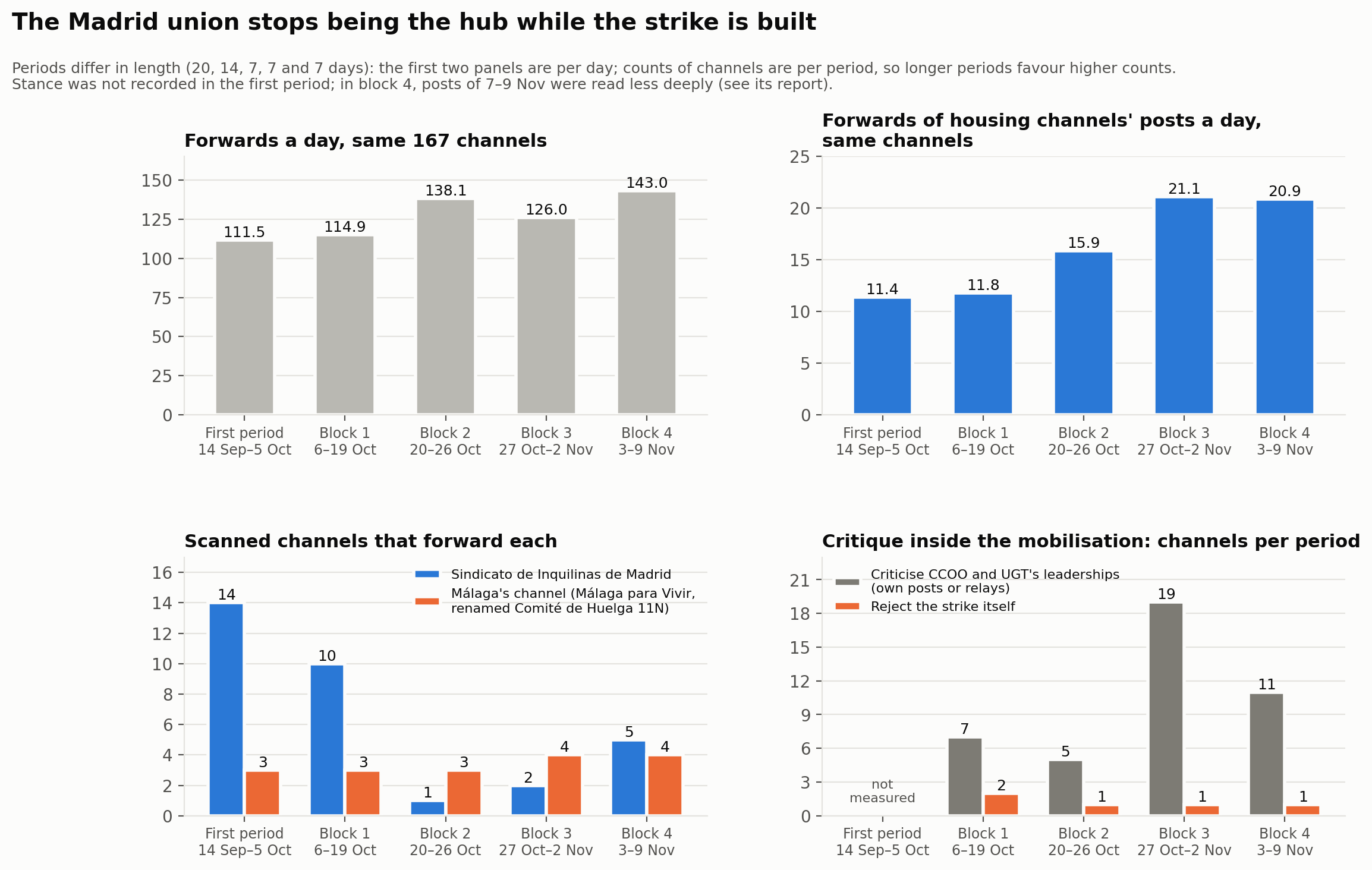
| First period | Block 1 | Block 2 | Block 3 | Block 4 | |
|---|---|---|---|---|---|
| Days | 14 Sep – 5 Oct (20) | 6–19 Oct (14) | 20–26 Oct (7) | 27 Oct – 2 Nov (7) | 3–9 Nov (7) |
| Channels in the panel at the end | 167 | 265 | 281 | 297 | 339 |
| Forwards a day, the first study’s 167 channels | 111.5 | 114.9 | 138.1 | 126.0 | 143.0 |
| Forwards of housing channels’ posts a day, same channels | 11.4 | 11.8 | 15.9 | 21.1 | 20.9 |
| Posts about the mobilisation a day, all channels | — | 101 | 73 | 76 | 166 |
| Channels forwarding the Sindicato de Inquilinas de Madrid | 14 | 10 | 1 | 2 | 5 |
| Channels forwarding Málaga’s strike committee channel | 3 | 3 | 3 | 4 | 4 |
| Channels criticising CCOO and UGT’s leaderships (own posts or relays) | — | 7 | 5 | 19 | 11 |
| Channels critical of the strike itself | — | 2 | 1 | 1 | 1 |
| Opponent channels | — | 2 | 2 | 2 | 3 |
| Share of forwards by the top five forwarders | 60 % | 51.1 % | 48.5 % | 46.5 % | 42.1 % |
| Communities (modularity) | 14 (0.60) | 13 (0.698) | 18 (0.735) | 19 (0.736) | 23 (0.744) |
| Agreement with the previous period’s communities (adjusted Rand index) | — | 0.512 | 0.586 | 0.587 | 0.403 |
“—”: not measured in that period. Posts about the mobilisation were not downloaded for the whole sample in the first study, and stance was not recorded. In block 4 the term list was widened, so its count of posts about the mobilisation is not strictly comparable, and posts of 7–9 November were read less deeply for stance (see the block’s report). Critique counts follow the rule revised on 10 November 2026; relays were found by reading the posts that name CCOO, UGT or union leaderships.
Main findings so far
- The Madrid union stops being the hub. In the first study the Sindicato de Inquilinas de Madrid was forwarded by 14 channels, more than any other housing channel. In block 1, after Maricarmen’s death, by 10; in blocks 2, 3 and 4, by 1, 2 and 5. It posts much less on its channel and, by its own account, no longer keeps a permanent post in Sol; it posted nothing about the camp’s eviction on 3 November.
- Málaga’s channel carries the forwarding of housing content. Málaga para Vivir, renamed “Comité de Huelga 11N · Málaga”, accounts for 98 of the 130 forwards of housing channels’ posts in block 2, 128 of 176 in block 3 and 132 in block 4. Its posts are forwarded by the same three or four channels many times each: volume without breadth.
- The mobilisation turns from the camps to the strike, and the strike’s supporters argue about who leads it. Posts in blocks 2 to 4 are almost all about building the 11 November strike, and in block 4, the week before it, posts about the mobilisation more than double (1,163 against 532, with a wider term list). Channels criticising CCOO and UGT’s leaderships, in their own posts or in relays, number 7, 5, 19 and 11 in blocks 1 to 4. Almost all back the strike, and several belong to organisations that signed the call, above all CGT, whose Madrid federation sent an open letter to CCOO and UGT; Granada’s housing union calls its own march. Channels that reject the strike itself stay marginal: one or two per block.
- Territorial clusters are linked below their housing channels. Up to block 3,
every forward between housing channels stays within Madrid, Barcelona, València or
Málaga. The first tie across territories appears in block 3, and it is a mention: a
joint statement by the camps of several cities after the Urda rail crash. In block 4
two ties cross territories: the Sindicat de Llogateres (Barcelona) forwards Llogateres
València, and the Sol camp’s channel links the Barcelona camp’s. The other channels of
each cluster are less closed:
- 7–11 % of the ties among channels with a known territory cross territories in each block. Anarchist and anti-repression collectives, Palestine solidarity groups and Catalan-language media (between Catalonia and València) carry most of them.
- 40–50 % of the other territorial channels have a tie to a state-wide channel, against a fifth to a third of the housing channels.
- Organisations present in several territories link them through their state-wide channels, not directly. CGT’s Madrid and Catalan channels both connect to its confederal channels; in blocks 1 and 3 the Madrid and Barcelona housing channels are three steps apart through CGT channels alone.
- Communities stay mostly territorial: about four in five channels sit in a community led by their own territory. Mixing is concentrated in the anarchist and antifascist community, in the CGT community of blocks 2 and 3 (with both camps in block 3), and between Catalonia and València.
Territories were assigned from each channel’s name, description and the places named in its posts; some assignments are uncertain.
- The camps’ own channels are relayed little, except at the Sol eviction. The Sol camp’s channel posted 50, 32, 11 and 33 times in the four blocks and was forwarded 3, 7, 2 and 9 times; in block 4 it was relayed by 7 channels, more than any other housing channel, and 8 of its 9 forwards came on the day of the eviction. The Barcelona camp’s channel posted 103, 24, 19 and 34 times and was forwarded once, once, not at all and 3 times.
- Barcelona’s housing unions emerge as a cluster of their own, and in block 3 the Sol and Barcelona camps sit in one community with the CGT unions that relay their posts. In block 4 each camp sits with its city: Madrid’s agendas, CGT, the Sol camp and the tenants’ union form one community, and Barcelona’s camp, housing unions and strike committees another. The other territorial clusters (València, Málaga with the Andalusian relay) persist from the first study.
- The opponents stay closed off. Two media channels are hostile in every block: Nuestra España Noticias and Multicanal Radio. Multicanal Radio forwards Nuestra España (149, 74, 76 and 88 times) and celebrity gossip; no other channel forwards or quotes either. Their hostility is in their own posts, for example Nuestra España’s headline “La ridícula huelga general que llega ocho años tarde” and Multicanal Radio’s “Sindicato de Inquilinas, la mano de la Revolución de la Ultra-izquierda”. In blocks 3 and 4 their stance rests on weaker evidence (adversarial headlines and mockery without an explicit attack); read as reporting, both would return to media. In block 4 a third opponent was admitted, an author’s channel (Cristina Martín Jiménez), on one post mocking the minister of Labour; it links RT’s channel and has no contact about the mobilisation with the rest of the panel. In the first study Multicanal Radio was the second-largest forwarder, tagged media, because there was no opponent category.
The strike day
The strike-day page reads the general strike of 11 November as a 29-hour window (10 November 22:00 to 12 November 03:00, Madrid time), against the same clock hours of two ordinary weekdays, 4 and 5 November. The window is part of block 5 and will be read again with the whole week.
- Many more posts, few more forwards. The panel posted 802 times about the mobilisation, 3.6 times as many as on the ordinary days, but forwarded only 15 % more (355 against 309). Road cuts, pickets and police charges were posted live; the morning’s press events appear on Telegram the same hour or earlier.
- Media and the conveners’ unions carried the day. La Directa, L’Accent, CCOO’s channels and UGT covered it hour by hour. The tenants’ unions posted little, and the camps’ channels were not forwarded at all.
- The territories stayed apart. The five forwarding ties between housing channels were all within one territory.
- Critique turned to the government, blamed for the police charges. No channel was critical of the strike itself, and critique of CCOO and UGT was rarer than in blocks 3 and 4.
- The opponents stayed closed off. They called the strike a failure and violent, and had no contact with the rest of the panel.
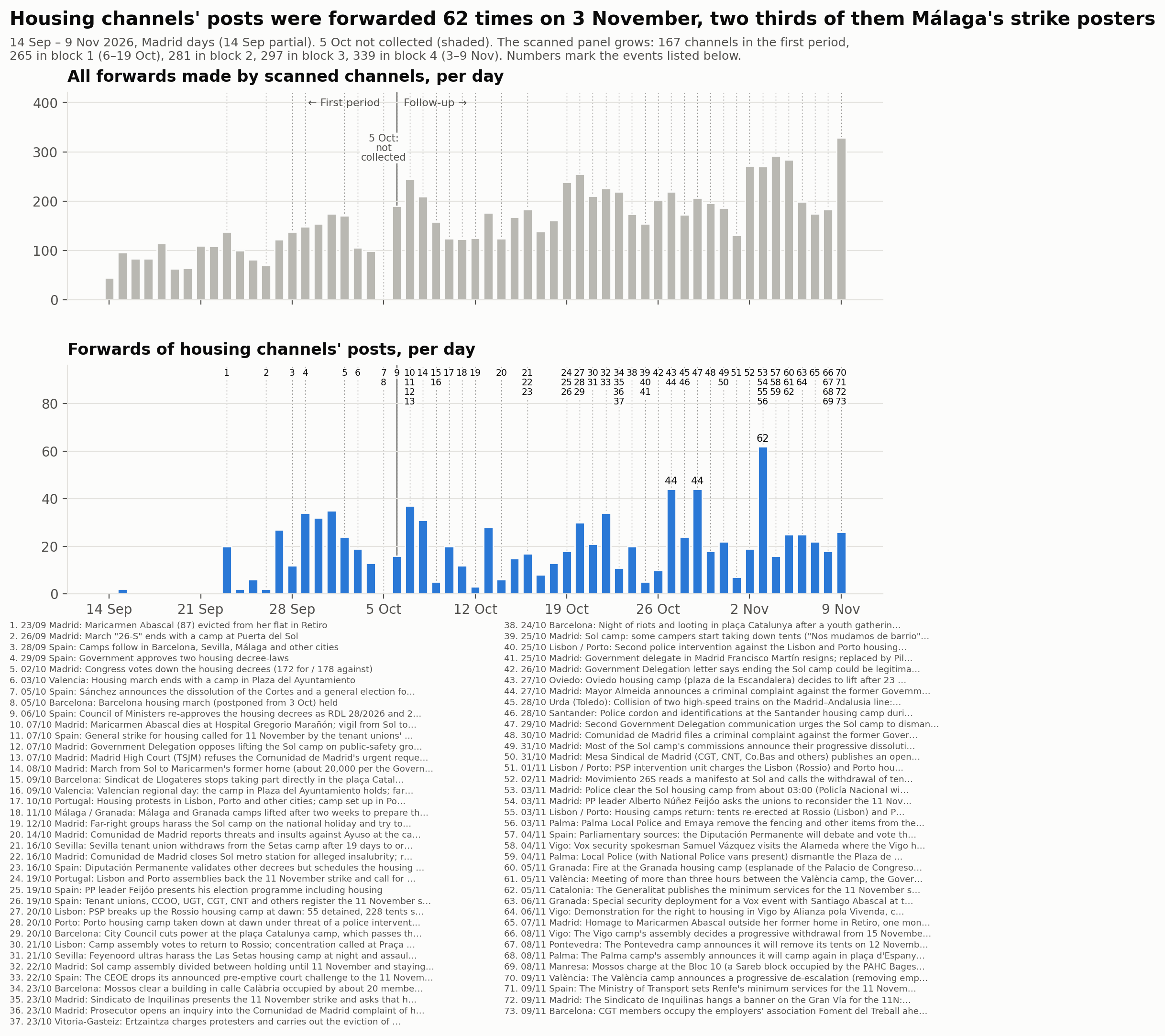
The continuous timeline
Limits
- The sample grows by design. Comparisons between periods are made on the same channels where it matters (the “same channels” rows above); totals over all channels are not comparable.
- Block lengths differ. Counts of channels per period favour the longer periods.
- Text only. Images, videos and linked articles were mostly not read.
- Private channels and groups are invisible, among them several camps’ and housing assemblies’ channels (see each block’s report).
- Stance and opponents are judgements, listed in each block’s report with the alternatives.
- Context comes from the press, with disagreements between sources noted in each block.
Cite this page.
DataPolitik (Heurística). Follow-up: 6 October to 12 November 2026. In Housing camps and Telegram communication networks in Spain, autumn 2026. Observation period: 6 October – 12 November 2026. Version of 13 November 2026. https://datapolitik.github.io/acampadas-vivienda-report/followup.html
Original text and figures: CC BY 4.0 · Use and citation

A DataPolitik study by Heurística. · Home · Follow-up overview